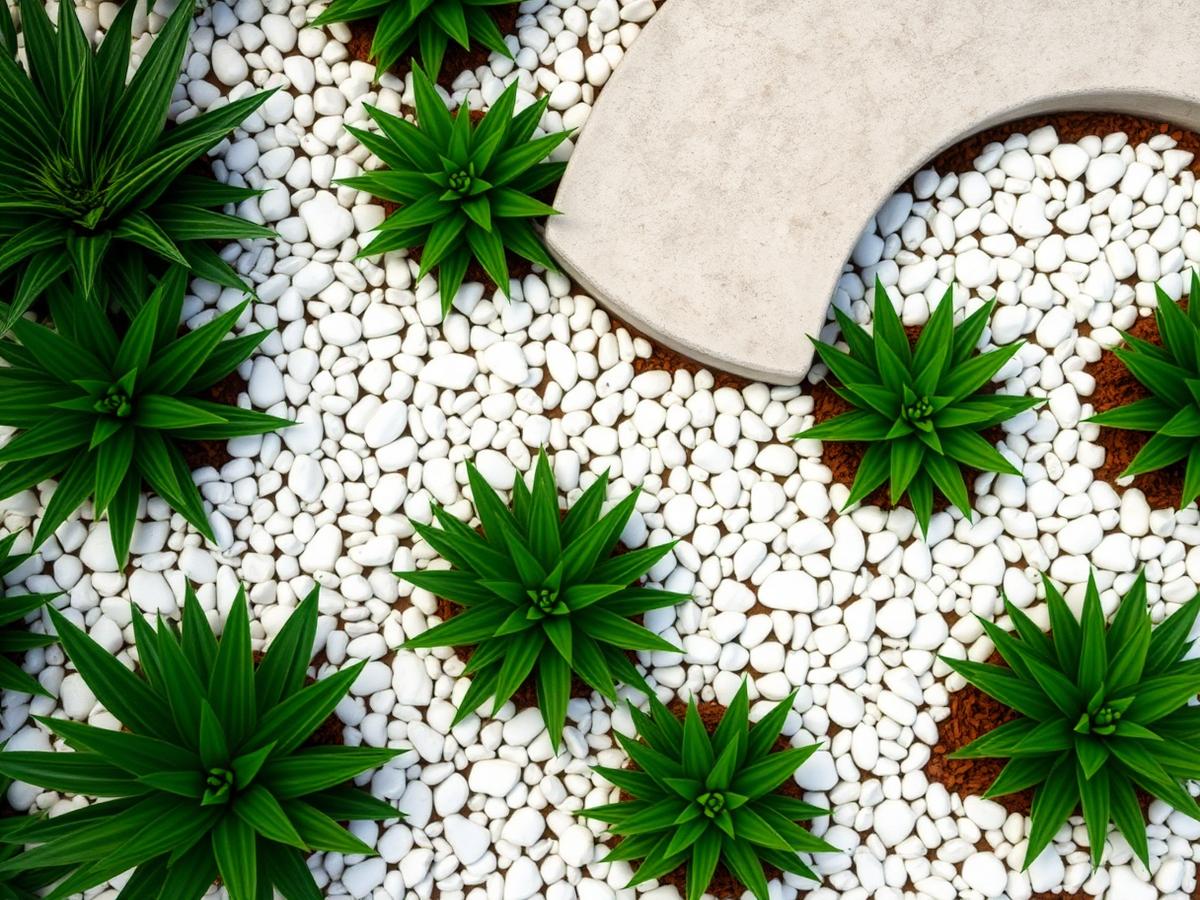
What marble chips actually are, and why the crushing matters
Marble chips are crushed marble, screened into size bands and sold as a loose decorative aggregate. That single word — crushed — explains almost everything about how the material behaves on site. Where river pebbles are shaped over decades by moving water into smooth, rounded forms, marble chips are broken out of larger blocks and offcuts by machine, so every piece carries fresh fractured faces, sharp edges and a crystalline sparkle where the break has exposed the interior of the stone. It is the reason a bed of chips reads as bright and crisp from across a courtyard while a bed of pebbles reads as soft and settled.
The angularity is not only an aesthetic difference, it is a structural one. Angular particles interlock. Push your hand into a tray of rounded pebbles and they roll away from each other; push it into marble chips and the pieces wedge together and resist. Once a chip bed is laid and lightly consolidated, the individual pieces brace against their neighbours, which is why chips hold a line on a mild slope, stay inside a narrow border strip, and sit quietly in a rooftop bed instead of migrating toward the outlets every monsoon.
Marble is also a soft carbonate stone rather than a hard silicate one. It cuts cleanly, takes a polish beautifully and can be ground dead flat after casting — which is precisely why the flooring trade adopted it long before the landscaping trade did. The same softness means marble chips are more open to acid attack and surface dulling than a quartz or granite aggregate would be. Understanding that trade-off up front is what separates a specification that still looks right in five years from one that disappoints in two.